EU's New €3 Duty: the Rise of HS Codes and Other Product Identifiers
|
7
min read

Share It On:
Quick Summary:
€3 duty applies to low-value EU e-commerce imports from 1 July 2026
The measure aims to improve fairness and customs oversight
HS codes will have a direct financial impact under the new customs regime
Other product-level identifiers such as SKUs/PIDs are expected to become more important for low-value e-commerce imports
Incorrect product classification can cause delays, fines and rejections
At x7trade, we closely follow regulatory changes at the EU level affecting cross-border e-commerce trade. Without a doubt, one of the most significant developments this year is the EU's temporary €3 flat-ratecustoms duty on low-value B2C e-commerce imports arriving from third countries.
For many years, low-value e-commerce goods entering the EU benefited from a customs duty exemption. From 1 July 2026, this exemption ended, with a temporary €3 flat-rate duty applying to cross-border B2C distant sales, expected to be in force for two years until 2028.
Introduced by Council Regulation (EU) No 2026/382, the measure removes the EUR 150 customs duty relief threshold and aims to strengthen customs controls, improve consumer safety, combat fraud, and create a more level playing field for EU merchants.
The Hidden Cost of "just €3"
At first glance, a €3 fee per product type/item may seem to be manageable if one purchases just one type of a product. However, its financial impact becomes much more visible when looking at how customs declarations are prepared or even more correctly, how the shipment manifests are prepared by shippers or logistics providers.
The following example, created by the x7trade team, illustrates how the structure of shipment manifest can influence the overall cost of the new duty regime.
In the case below, one parcel contains four items worth of €26.98 in total intrinsic value:
three plastic washers with different supplier product codes (which may be viewed as product-level identifiers) but sharing the same commodity description and HS code (392690);
one screwdriver with a different commodity description and HS code (820540).
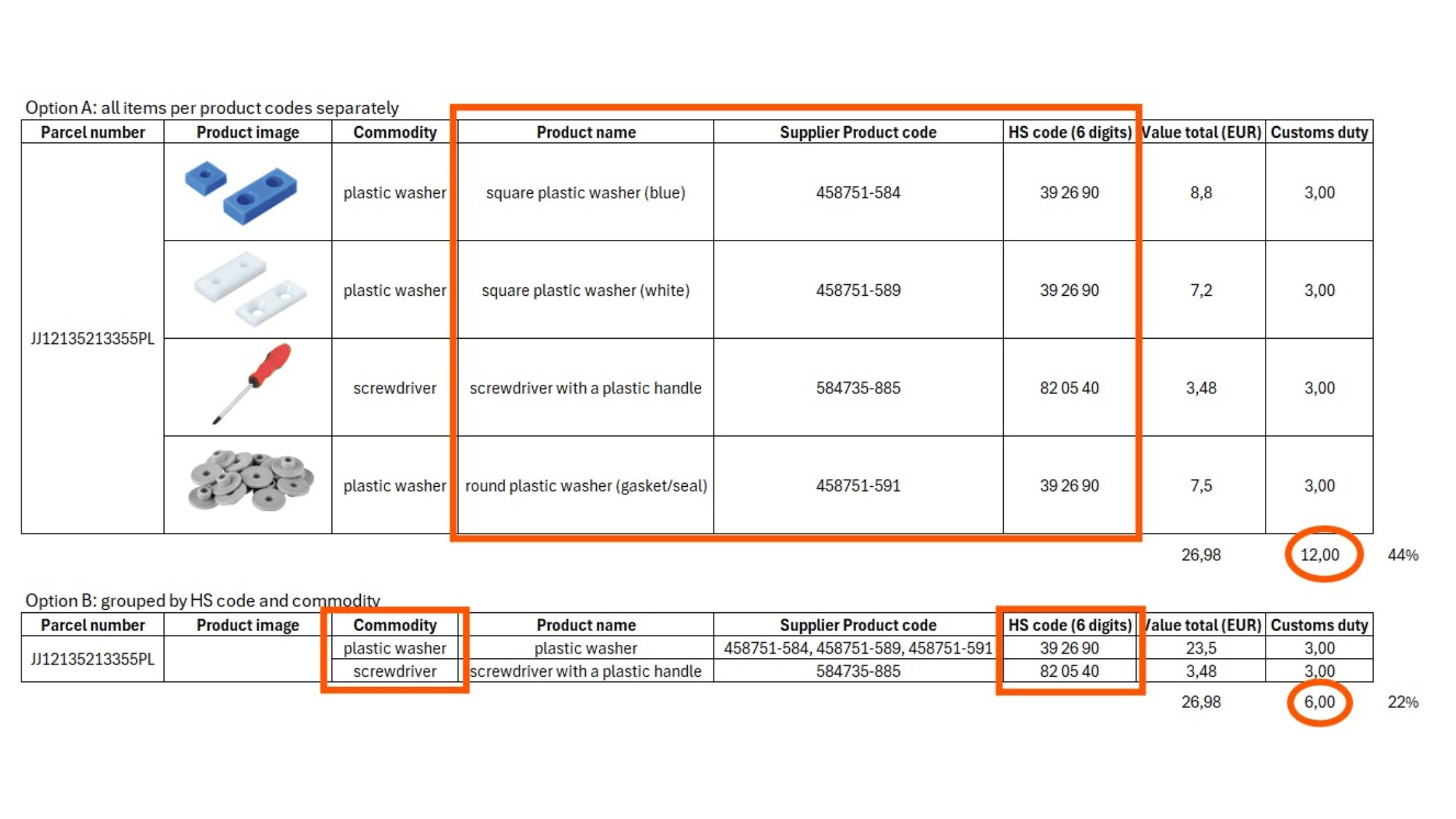
If every item is declared on a separate customs line (Option A) because one of the product identifiers (product code in this case) is unique in every case, customs will identify four product lines. The total customs duty therefore reaches €12, representing 44% of the parcel's intrinsic value.
However, if the three washers are consolidated into a single customs line because they share the same commodity description and HS code (Option B), the total customs duty falls to just €6, representing 22% of the parcel's intrinsic value.
Here we arrive at two important conclusions:
I) Merchants and shippers have all the incentives to “group” the products if the HS code and product description are the same. We can even talk about the possibility of misusing or overusing the grouping under the same HS code that can prompt the customs to intervene and investigate.
II) While Option B is pretty much the standard today, Option A could soon become unavoidable, as product identifiers (other than HS codes) may also become mandatory. We will discuss this in more detail below.
Product-Level Visibility is just around the corner?
As we established in the example above, all three washers share the same commodity description and HS code, although each has a different Supplier Product Code. These codes are an example of product-level identifiers. Today, these identifiers are largely ignored for the purpose of calculating the €3 duty fee. But that could change soon.
Starting from November 2026, the EU is expected to introduce Product Identifier (PID) requirements for many low-value e-commerce imports. This means that customs authorities in the EU will not only rely on the category-level information.
Depending on the product, shipment manifests and thus customs declarations may need to include identifiers such as merchant’s Stock Keeping Units (SKUs), manufacturer product IDs or standardized identifiers like EAN numbers.
In bigger picture this means that the customs controls in the EU will be moving from category-based visibility ("What type of product is this?") to product-level visibility ("Which exact product is this?"). This approach is driven by several objectives, including improving product safety, strengthening compliance and making it easier for authorities to identify potential risks.
In other words, the more product identifiers will be required in the shipment manifest and later in the customs declaration, the more difficult it will be for shippers to "group” similar products under the same HS code.
“To be prepared is half the victory”
While the €3 duty charge has attracted most of the attention, efficiently managing customs declarations will become highly important for businesses handling large volumes of low-value e-commerce shipments.
The x7trade team encourages businesses across the e-commerce supply chain to focus more on declaration structure and product data quality, as costs and penalties for non-compliance will significantly rise.
At x7trade, we help businesses automate customs clearance processes, including H7 and H1 declarations. And even if the provided product identifies are wrong or missing, our platform allows you to correct them and resubmit the declarations.
So, don't stress about new regulations. Book a demo with x7trade and make smart automation part of your customs clearance process.
Glossary
HS Code (Harmonized System Code)
An internationally standardized code used to classify goods for customs purposes. It determines the applicable customs duties, restrictions and statistical reporting requirements.
SKU (Stock Keeping Unit)
A product identifier created by a retailer or marketplace to identify a specific product or product variant within its own inventory system. SKUs are not standardized globally.
PID (Product Identifier)
A product identifier required under the EU's new customs framework to improve product traceability. Depending on the product, this may include a merchant product identifier (such as a marketplace SKU), a manufacturer product identifier or a standardized identifier.
EAN (European Article Number)
A globally recognized barcode standard used to identify retail products. Where available, it may be reported as the standardized Product Identifier (S-PID).
Customs Clearance
The process of submitting customs declarations and obtaining customs approval for imported or exported goods.
H7 declaration
A simplified customs declaration used for importing low-value consignments (typically goods with an intrinsic value of up to EUR 150) into the EU. It contains key information about the goods, such as product description, value, origin and classification details, allowing customs authorities to assess and process the import.